Successful aesthetic outcomes begin long before the treatment itself. A thorough patient assessment helps practitioners identify clinical indications, manage expectations, reduce risk, and create treatment plans that are both safe and appropriate. In medical aesthetics, consultation is not just a formality; it is a critical part of the clinical process.
Why Patient Assessment Matters
Every patient presents with a unique combination of anatomical features, skin quality, ageing patterns, medical history, and aesthetic goals. A standardized assessment framework allows practitioners to make more informed decisions while improving communication and patient trust.
A complete pre-treatment evaluation can help:
- Identify contraindications and risk factors
- Clarify the patient’s primary concerns and motivations
- Establish realistic treatment goals
- Support safe product and technique selection
- Improve long-term treatment planning
1. Start With the Patient’s Chief Concern
The consultation should begin by understanding what the patient wants to improve and why. Some patients arrive with a clear concern, such as volume loss, skin laxity, or dynamic lines. Others may describe a general feeling of looking tired or older without identifying a specific anatomical issue.
Open-ended questions are useful at this stage. The goal is to understand both the visible concern and the emotional motivation behind it. This creates the basis for a more accurate and patient-centered treatment plan.
2. Review Medical History Carefully
A full medical history is essential before any aesthetic intervention. Practitioners should review:
- Current and past medical conditions
- Allergies and hypersensitivity reactions
- Current medications and supplements
- Previous aesthetic treatments and outcomes
- History of autoimmune disease, bleeding disorders, or infection
- Pregnancy or breastfeeding status where relevant
Even in minimally invasive procedures, overlooking systemic risk factors can lead to preventable complications. Documentation should be clear, complete, and updated regularly.
3. Evaluate Facial Anatomy and Skin Quality
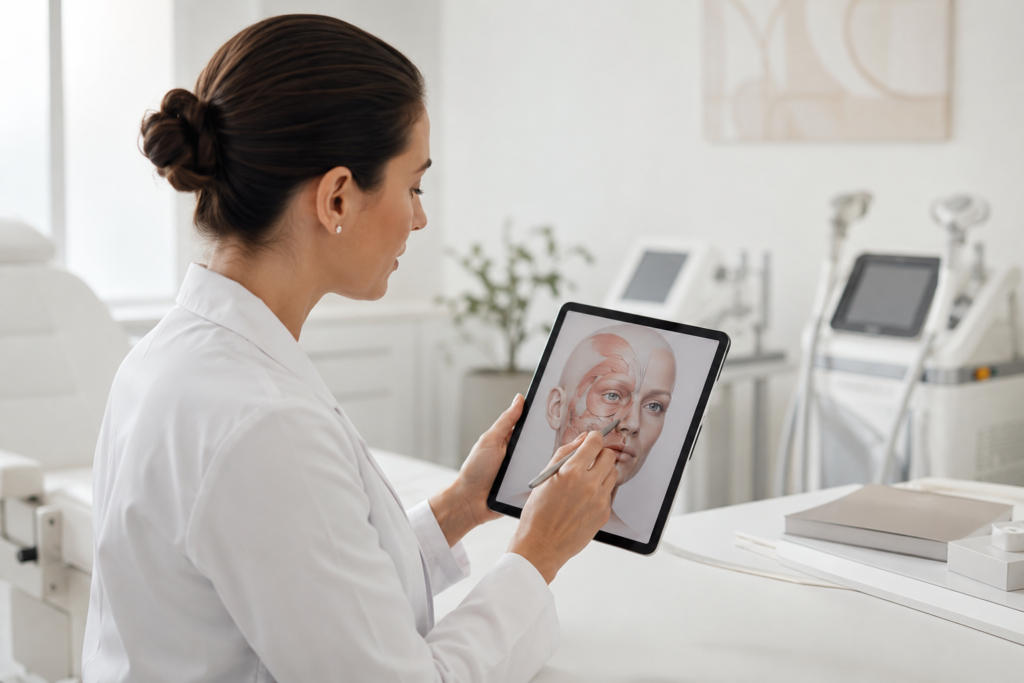
Clinical assessment should include both static and dynamic evaluation. At rest, practitioners should observe facial proportions, symmetry, volume distribution, and skin condition. During movement, expression patterns can reveal muscle activity, line formation, and the interaction between facial structure and motion.
Important factors to assess include:
- Skin thickness and hydration
- Elasticity and degree of laxity
- Volume loss and structural support
- Facial asymmetry
- Pattern of ageing across upper, mid, and lower face
This step is especially important when treatment decisions involve neuromodulators, fillers, skin boosters, or combination protocols.
4. Assess Suitability, Not Just Demand
Not every requested treatment is the right treatment. One of the practitioner’s most important responsibilities is to determine whether the patient is an appropriate candidate for the procedure being considered.
This includes clinical suitability, but also emotional readiness, expectation management, and understanding whether the proposed intervention will genuinely address the presenting concern. Ethical consultation means guiding patients toward appropriate care, even when it differs from their initial request.
5. Set Realistic Expectations
Clear communication is central to patient satisfaction. Practitioners should explain what the treatment can achieve, what it cannot achieve, how many sessions may be needed, what downtime to expect, and what possible side effects or complications may occur.
Patients should leave the consultation with a realistic understanding of outcomes rather than an idealized expectation. In many cases, dissatisfaction comes not from poor technique, but from poor expectation alignment.
6. Discuss a Long-Term Treatment Plan
Medical aesthetics should be approached strategically rather than as a series of isolated procedures. Once the immediate concern has been assessed, practitioners can introduce the concept of staged treatment planning based on anatomy, priorities, budget, and safety.
A long-term plan may include:
- Immediate correction of the primary concern
- Preventive or maintenance treatments
- Adjunctive skin quality protocols
- Review timelines and reassessment points
This approach supports better clinical outcomes and positions the practitioner as a trusted medical advisor rather than only a treatment provider.
7. Document Everything
Photographic documentation, charting, consent, and treatment rationale should all be part of the pre-treatment workflow. Standardized records improve continuity of care and provide valuable reference for follow-up and future planning.
Pre-treatment photographs should be taken using consistent lighting, angles, and expressions wherever possible. Good documentation is not only protective from a medico-legal perspective, but also clinically useful in tracking progress over time.
Conclusion
Patient assessment is one of the most important stages in aesthetic practice. A structured consultation helps practitioners improve safety, refine treatment selection, and deliver outcomes that are both clinically sound and aligned with patient goals. In a field where trust, precision, and judgement are essential, high-quality assessment remains the foundation of responsible aesthetic medicine.